New from Blackwater Press—Arthur Conolly, Victorian Spy
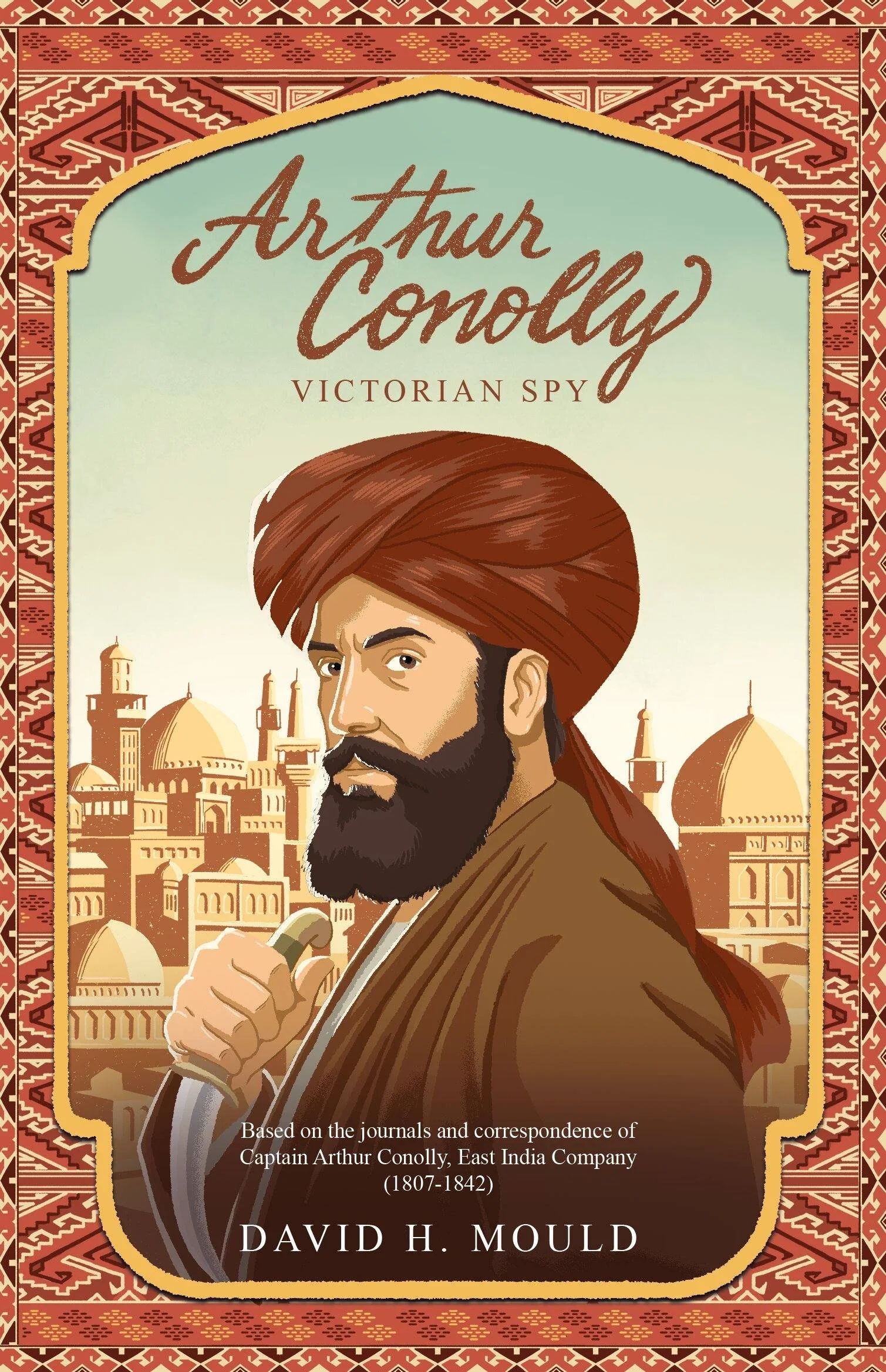
In September 1840, Captain Arthur Conolly, an intelligence officer in the East India Company, set out from Afghanistan’s capital, Kabul, for Central Asia. His orders were to assess the military capacity of the kingdoms of Khiva, Kokand and Bokhara, and persuade their rulers to unite to resist Russian advances and open their markets to British goods. Conolly, a devout Christian and abolitionist, had a higher agenda: to free thousands of slaves, and pave the way for missionaries.
Writing to a fellow officer, he described his mission as part of a “great game.” Quoted by Rudyard Kipling in his novel Kim, historians would use the phrase to describe the geopolitical rivalry between the two nineteenth century superpowers, Victorian Britain and Tsarist Russia, in a vast area from Persia to Tibet.
This was not Conolly’s first adventure; a decade earlier, often disguised as a Hindustani merchant in a turban and native garb, he had undertaken a 5,000-mile, 18-month overland journey from St. Petersburg in Russia to India to gather intelligence on Russian invasion routes.
The khans of Khiva and Kokand, already at war with each other, were not ready for an alliance, but warned Conolly not to travel to Bokhara, where the emir had imprisoned a British officer whom he suspected of spying. Conolly went anyway, and was promptly arrested and thrown into prison.
Eighteen months later, sketchy accounts reached London that the two officers had been executed, but were contradicted by reports that they were rotting in a cell in the emir’s palace. It would take an expedition from England by an eccentric, multilingual clergyman to learn the truth.
Paperback and e-book available for pre-order at https://www.blackwaterpress.com/product/arthur-conolly-victorian-spy/ Publication date: 8 September 2026
The legendary “Great Game” of imperial rivalry in Central Asia began long before it was immortalised by Rudyard Kipling. At its centre stood the British officer and spy Arthur Conolly, whose daring missions and tragic death in Bokhara epitomised the risks of nineteenth-century intelligence work. Reconstructing Conolly’s world, this book reveals how the improvisational espionage of empire laid the foundations for the modern intelligence systems that still shape global strategy today.
—Peter John Brobst, Associate Professor of History, Ohio University, author of The Future of The Great Game: Sir Olaf Caroe, India’s Independence, and the Defense of Asia (University of Akron Press, 2005)
The more one considers the complexity of Connolly’s life and times as a British agent, the more one comes to respect the skill of David Mould as a writer and historian. Though the events in this book took place nearly 200 years ago, the setting is very relevant when one considers the current turmoil in Afghanistan, Russia, and Iran.
—Pete Kosky, author and historian
Arthur Connolly was a man with a vision and impressive faith who ranged over tremendous distances and overcame hardships and risk in pursuit of his ideals and service to his country. A story set in the context of the competition between Great Britain and Imperial Russia, featuring medieval states and opportunistic highwaymen.
—John Brennan, Ohio University